“Exercise pills” and fat-enzyme blockers have only been tested in mice
SLU-PP-332 and 5-Amino-1MQ reduced fat in obese mice. Neither is a peptide, and neither has been tested in people.
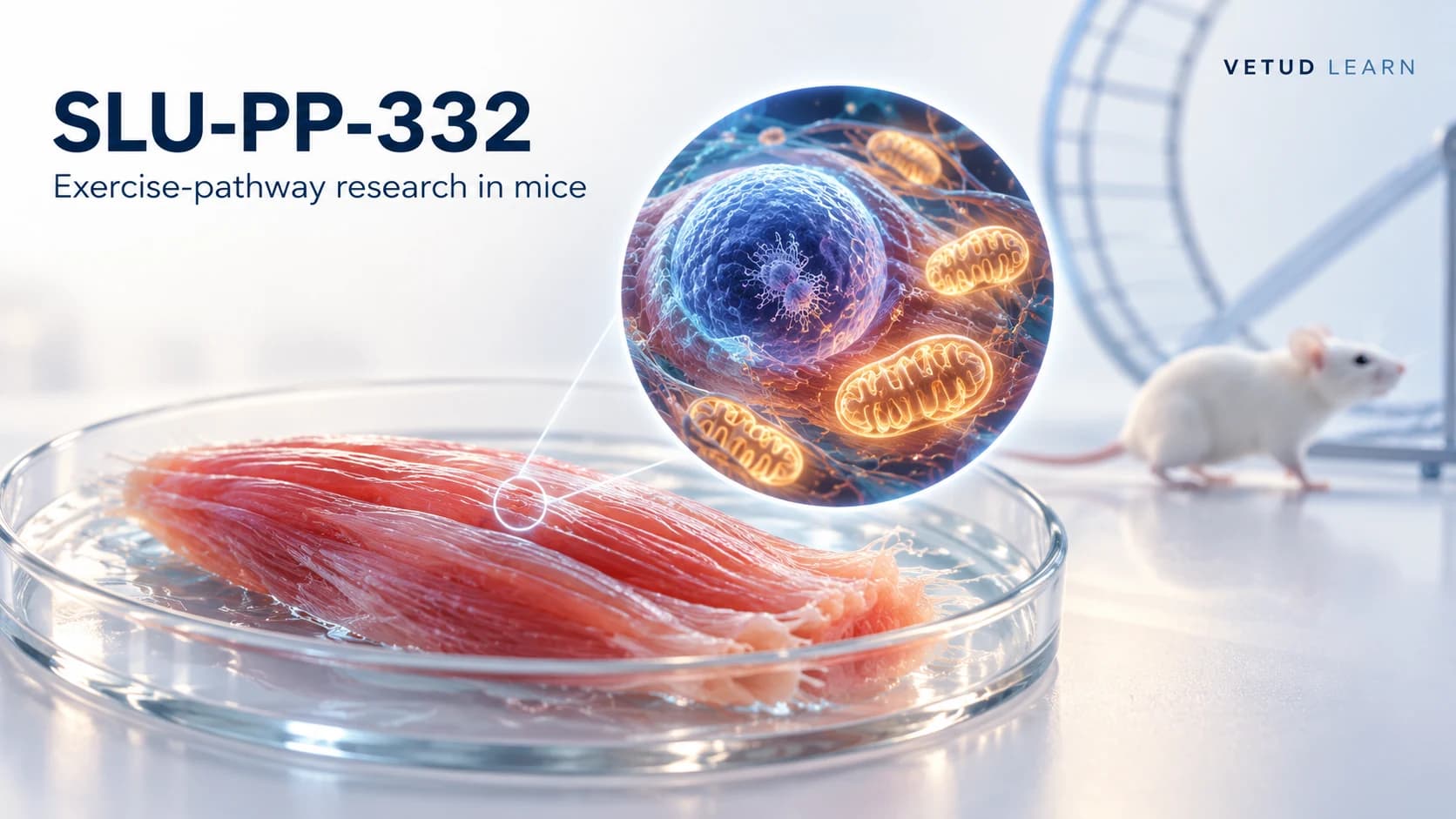
The study at a glance
- SLU-PP-332
- Switches on ERR receptors behind part of the exercise response; tested in two kinds of obese mice (2024)
- Its results
- More energy use and fat burning, less fat gain, better insulin sensitivity
- 5-Amino-1MQ
- Blocks NNMT, an enzyme active in fat; 11-day study in diet-induced obese mice, 9 treated and 9 controls (2018)
- Its results
- About 5% weight loss vs a 1.4% gain in controls; about 35% less white fat
- In people
- No published human trials for either
The research, explained
Two compounds often sold next to peptides promise a shortcut: SLU-PP-332, nicknamed an “exercise pill”, and 5-Amino-1MQ, which blocks an enzyme in fat tissue. Both are small chemicals, not peptides.
SLU-PP-332 switches on estrogen-related receptors (ERRs), which help muscles adapt to aerobic exercise. In a 2024 study, it was given to diet-induced obese mice and to ob/ob mice, which are genetically prone to obesity. It increased energy use and fat burning, reduced fat-mass gain and improved insulin sensitivity, mimicking some effects of exercise.
5-Amino-1MQ blocks NNMT, an enzyme especially active in fat. In a 2018 study, nine obese mice received it for 11 days while nine controls did not. Treated mice lost about 5.1% of their weight, while controls gained about 1.4%, and one white-fat store was about 35% smaller. The mice did not eat less, and no adverse effects were observed.
Mouse results often fail to carry over to people. Neither compound has published human trials, so nothing is known about their effects, side effects or long-term safety in people. Exercise also affects the heart, brain, bones and mood; these studies measured fat and insulin.
The peptide MOTS-c has a similar story: in its 2015 discovery study it protected mice on a high-fat diet from weight gain and insulin resistance, and human trials are lacking.
Research materials for these compounds, where listed, are in the research shop for laboratory use.
What does this mean?
These are interesting early leads in metabolic research. They are not evidence of fat loss or fitness benefits in people.
What don’t we know yet?
Effectiveness and safety in people are entirely unknown for both compounds.
Watch and learn
Videos discussing the compounds in this article, plus background on the biology or the research methods. Each card explains its connection; recordings may predate the findings described here.
Pain Specialists Australia
BPC-157 for pain: what the evidence actually says
Two pain specialists weigh the evidence and the risks of BPC-157, TB-500, ARA-290, MOTS-c and GHK-Cu, including contamination of products sold online.
Dr Nick Christelis and Dr Bradley Lewinsohn, specialist pain medicine physicians (FFPMANZCA)
Discusses the compound
Two specialist pain physicians review the evidence for BPC-157 (from 16:08), TB-500 (24:04), ARA-290 (4:54), MOTS-c (25:51) and GHK-Cu (24:56), and the risks of unregulated products.
U.S. Food and Drug Administration
FDA peptide compounding meeting: July 23, 2026
Full meeting covering BPC-157, KPV, TB-500 and MOTS-c. Advisory discussion is not drug approval.
Official FDA advisory committee recording
Official regulatory recording
The original July 23, 2026 FDA discussion of BPC-157, KPV, TB-500 and MOTS-c; it documents an advisory review.
Khan Academy
Mitochondria: structure and cellular energy
A foundation for reading mitochondrial research. It does not demonstrate a benefit from any experimental compound.
Biology education
Related biology
Background on mitochondria and cellular energy for understanding SLU-PP-332, 5-Amino-1MQ, MOTS-c. It does not demonstrate benefits of this compound or formulation.
Sources and references
- A Synthetic ERR Agonist Alleviates Metabolic SyndromeBillon et al. · Journal of Pharmacology and Experimental Therapeutics · 2024
- Selective and membrane-permeable small molecule inhibitors of nicotinamide N-methyltransferase reverse high fat diet-induced obesity in miceNeelakantan et al. · Biochemical Pharmacology · 2018
- The mitochondrial-derived peptide MOTS-c promotes metabolic homeostasis and reduces obesity and insulin resistanceLee et al. · Cell Metabolism · 2015
VETUD Learn explains published research in plain language. It is general information, not medical advice. Talk to a doctor before starting, stopping or changing any treatment.
In the research shop
Check the catalog for related laboratory research materials. These products are separate from the approved medicines and clinical trial formulations discussed here.
Checking regional availability…