
SS-31 became the first approved mitochondria-targeted medicine
Elamipretide (Forzinity) won accelerated FDA approval for Barth syndrome in September 2025, based on leg-muscle strength. A further trial must confirm the benefit.
The study at a glance
- Medicine
- Elamipretide (SS-31), sold as Forzinity
- Approved for
- Barth syndrome, in patients weighing at least 30 kg (US, September 19, 2025)
- Basis
- Stronger muscle for straightening the knee; an accelerated approval
- Long-term data
- 10 patients in an open-label extension; 6-minute walk +96.1 m at week 168
- Next
- A randomized, placebo-controlled confirmatory trial is required
The research, explained
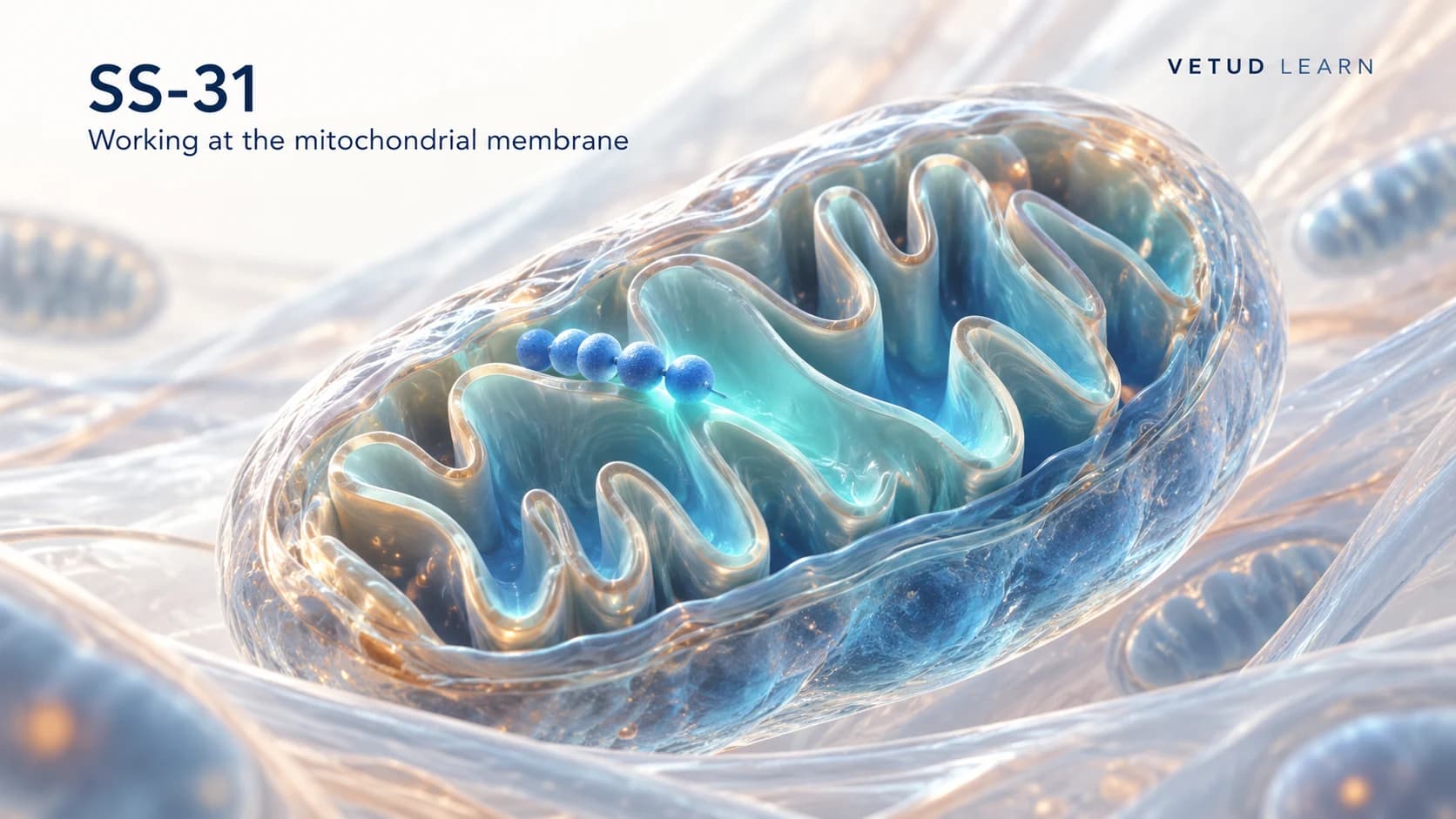
Mitochondria are the power plants inside our cells. SS-31, now called elamipretide, is a small peptide designed to travel into them and settle on their inner membrane, where it helps them keep their structure and work properly.
Barth syndrome is a rare inherited disease in which faulty mitochondria weaken the heart and muscles. On September 19, 2025, the FDA granted elamipretide accelerated approval as Forzinity, the first treatment for the disease, for patients weighing at least 30 kg.
The decision rested on improved strength of the muscle that straightens the leg at the knee, which the FDA considers reasonably likely to predict real benefit. The company must run a randomized, double-blind, placebo-controlled trial to confirm it. Injection-site reactions were the most common side effect.
Longer-term data come from the TAZPOWER study. After a 28-week placebo-controlled phase, 10 patients continued on elamipretide in an open-label extension, and 8 reached week 168. Their 6-minute walking distance improved by a cumulative 96.1 meters, and fatigue scores stayed better than at the start. Without a comparison group, some of that change could have other causes.
Other “mitochondrial” compounds are at a much earlier stage. MOTS-c, a peptide encoded in mitochondrial DNA, has mainly been studied in mice. NAD+ is a coenzyme, not a peptide, and human studies of NAD+ boosters are mostly small. Our article on mouse-only “exercise pills” covers two more.
SS-31 research material, where listed, is in the research shop; it is not the approved medicine.
What does this mean?
Elamipretide shows that targeting mitochondria can produce an approved medicine, for one rare disease, on condition that a confirmatory trial follows.
What don’t we know yet?
The confirmatory trial result, and any benefit in other conditions, are still to come. Several authors of the long-term study work for the developer, Stealth BioTherapeutics.
Watch and learn
Videos discussing the compounds in this article, plus background on the biology or the research methods. Each card explains its connection; recordings may predate the findings described here.
Pain Specialists Australia
BPC-157 for pain: what the evidence actually says
Two pain specialists weigh the evidence and the risks of BPC-157, TB-500, ARA-290, MOTS-c and GHK-Cu, including contamination of products sold online.
Dr Nick Christelis and Dr Bradley Lewinsohn, specialist pain medicine physicians (FFPMANZCA)
Discusses the compound
Two specialist pain physicians review the evidence for BPC-157 (from 16:08), TB-500 (24:04), ARA-290 (4:54), MOTS-c (25:51) and GHK-Cu (24:56), and the risks of unregulated products.
U.S. Food and Drug Administration
FDA peptide compounding meeting: July 23, 2026
Full meeting covering BPC-157, KPV, TB-500 and MOTS-c. Advisory discussion is not drug approval.
Official FDA advisory committee recording
Official regulatory recording
The original July 23, 2026 FDA discussion of BPC-157, KPV, TB-500 and MOTS-c; it documents an advisory review.
Khan Academy
Mitochondria: structure and cellular energy
A foundation for reading mitochondrial research. It does not demonstrate a benefit from any experimental compound.
Biology education
Related biology
Background on mitochondria and cellular energy for understanding SS-31, MOTS-c, NAD+. It does not demonstrate benefits of this compound or formulation.
Sources and references
- FDA grants accelerated approval for first treatment for Barth syndromeUS Food and Drug Administration · September 2025
- Long-term efficacy and safety of elamipretide in patients with Barth syndrome: 168-week open-label extension results of TAZPOWERThompson et al. · Genetics in Medicine · 2024
- The mitochondrial-derived peptide MOTS-c promotes metabolic homeostasis and reduces obesity and insulin resistanceLee et al. · Cell Metabolism · 2015
VETUD Learn explains published research in plain language. It is general information, not medical advice. Talk to a doctor before starting, stopping or changing any treatment.
In the research shop
Check the catalog for related laboratory research materials. These products are separate from the approved medicines and clinical trial formulations discussed here.
Checking regional availability…