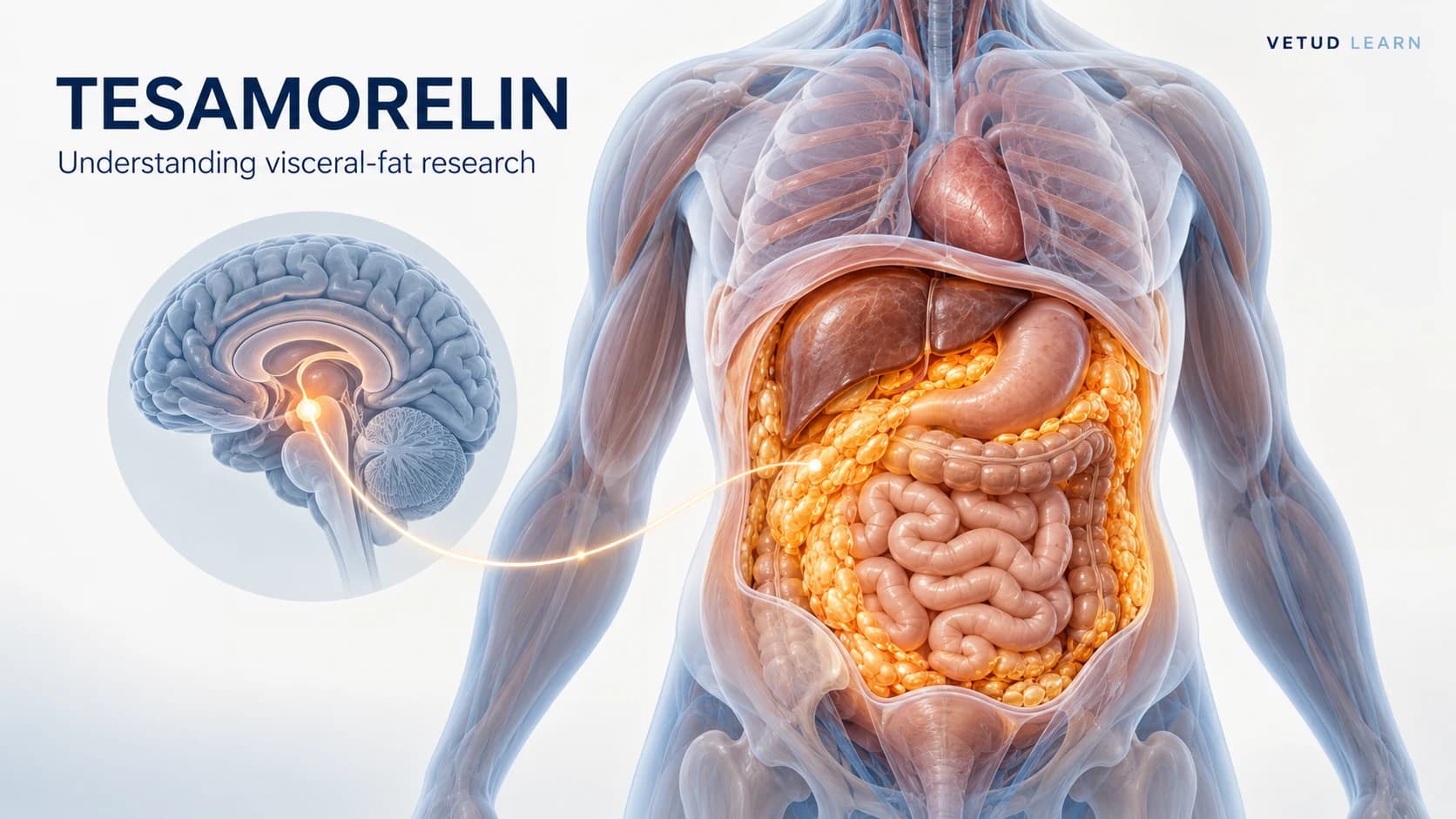
Body weight, fat and muscle: read the right result
A percentage means little without its denominator. Learn why changes in body weight, a fat deposit and a measurement in rats belong in different comparisons.

At a glance
- Body weight
- The change in total weight, usually relative to starting weight
- Fat volume
- A measured fat compartment, reported in units such as mL or as its own percentage change
- Muscle outcomes
- Check whether the study measured mass, size, strength or function
- Control comparison
- A difference versus a control group is not automatically the change from baseline
The research, explained
Start by naming the outcome. Total body weight, visceral-fat volume and muscle strength are different measurements. Giving each a percentage sign does not make them interchangeable.
Here is an illustrative calculation, not a trial result: a change from 100 kg to 90 kg is a 10% reduction in body weight. A scan showing a fat compartment changing from 1,000 mL to 900 mL is a 10% reduction in that compartment. The second calculation does not tell us that the person lost 10 kg.
Also ask what the percentage is relative to. A change from a participant’s own starting value differs from a difference between treated and control groups. If control animals gain weight, a lower weight versus those animals need not represent the same percentage lost from the treated animals’ starting weight.
Muscle claims need their own outcome. Look for what was measured and how it was measured, whether strength or function was assessed, and how long any difference lasted. Do not assume that a reduction in total weight identifies the tissue that changed.
The examples in our library make this distinction concrete. Retatrutide trials report average human body-weight change. The cited CBL-514 work examines fat deposits, while the PTT-A findings discussed here come from animal experiments. Their numbers answer different questions.
Even human weight-loss trials can differ in participants, treatment duration, accompanying care and analysis. Use the chart to explore reported results, then open each source before deciding how closely two studies can be compared.
What does this mean?
Ask: percentage of what, compared with what, in which population and over how long? Those four questions prevent many misleading comparisons.
What don’t we know yet?
A single percentage cannot establish long-term benefit, tissue-specific change or safety. An average also does not predict the result for an individual.
Watch and learn
Use these lessons to identify the question a study asked and to separate a measured result from a broader treatment claim.
National Institute of Mental Health
Different types of clinical research
An introduction to the different questions and designs used in studies involving people.
NIMH · US National Institutes of Health
Research skills
Helps you judge the study design or uncertainty in Retatrutide, CBL-514, PTT-A research; it is not a trial of the compound.
Ohio State Wexner Medical Center
Avoiding weight regain after GLP-1 medication
Clinical context for weight maintenance after GLP-1 treatment. It does not test CBL-514 or other experimental add-ons.
University hospital patient education
Related biology
Background on weight maintenance after GLP-1 treatment for understanding Retatrutide, CBL-514, PTT-A. It does not demonstrate benefits of this compound or formulation.
National Institute of Mental Health
What is clinical research?
Why studies in people are needed and what clinical research is designed to establish.
NIMH · US National Institutes of Health
Research skills
Helps you judge the study design or uncertainty in Retatrutide, CBL-514, PTT-A research; it is not a trial of the compound.
Sources and references
- Retatrutide phase 2 obesity trialJastreboff et al. · New England Journal of Medicine · human body-weight outcome
- Efficacy and safety of CBL-514 injection in reducing abdominal subcutaneous fatGold et al. · Aesthetic Surgery Journal · randomized phase 2 study · 2025
- CBL-514: visceral-fat subgroup and weight-regain research at EASD 2026EASD press-room report reproduced by Caliway · preliminary conference findings · October 2, 2026
- PTT-A tetra-agonist compared with tirzepatide in diet-induced obese rats (85-OR)Ghosh et al. · Diabetes · ADA conference abstract · 2025
VETUD Learn explains published research in plain language. It is general information, not medical advice. Talk to a doctor before starting, stopping or changing any treatment.
In the research shop
Check the catalog for related laboratory research materials. These products are separate from the approved medicines and clinical trial formulations discussed here.
Checking regional availability…