AOD-9604: the growth hormone fragment that never became a medicine
It cut weight gain in obese rodents and looked as well tolerated as placebo in human trials. We could not find a full peer-reviewed report of human weight loss.
At a glance
- What it is
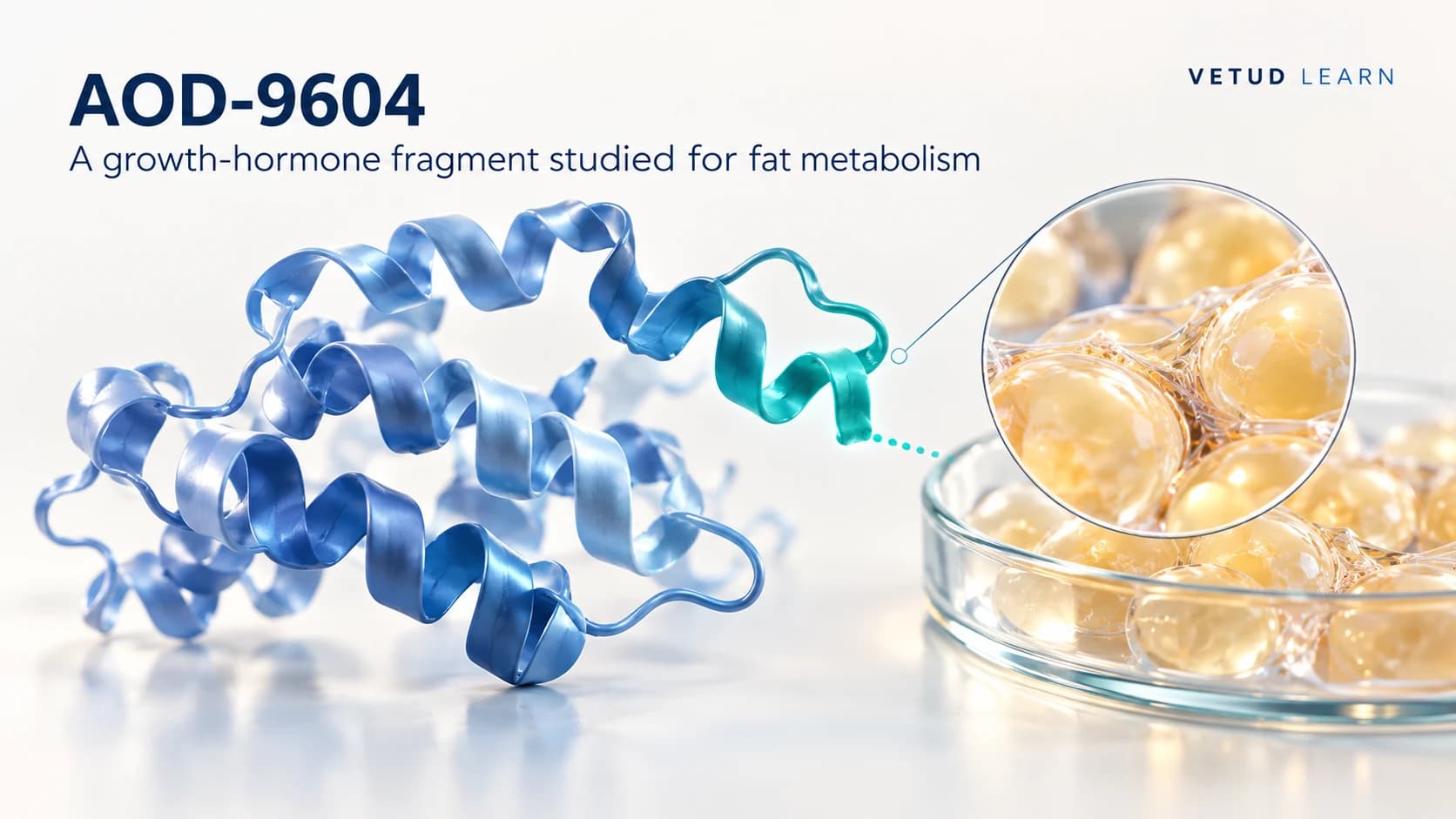
- A modified piece of growth hormone, around building blocks 177 to 191; sold alongside “fragment 176-191”
- Animals
- Obese rats gained less than half as much weight as untreated rats over 19 days (2000)
- Human safety
- Six placebo-controlled trials: tolerability “indistinguishable from placebo”, no change in IGF-1 (2013)
- Human weight loss
- No full peer-reviewed report found among 23 PubMed records (November 2026)
- Status
- Never approved as a medicine
The research, explained
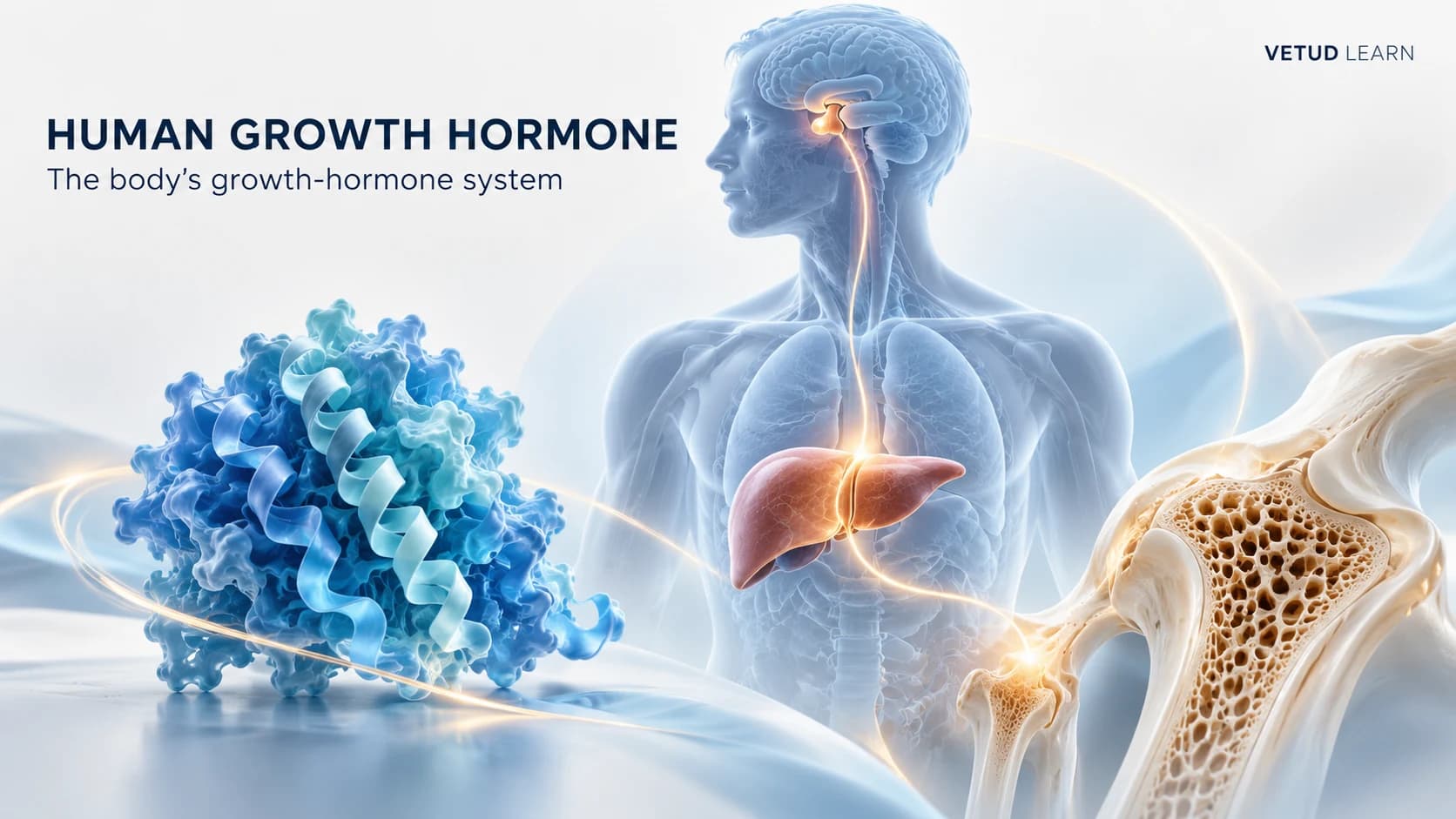
Growth hormone breaks down fat, but it also affects growth and blood sugar. Australian researchers asked whether a small piece from the end of the hormone could keep the fat-burning effect on its own. The result was AOD-9604, a modified copy of the stretch around building blocks 177 to 191.
Animal results were encouraging. In obese rats given AOD-9604 by mouth for 19 days, weight gain was cut by more than half compared with untreated rats (15.8 g versus 35.6 g), without the loss of insulin sensitivity seen with full growth hormone. In obese mice it increased fat burning, and unlike growth hormone it did not bind the growth hormone receptor or make cells multiply.
It then moved into human trials as an obesity drug; by February 2002, phase 2a trials were under way. A 2013 paper pooled safety data from six randomized, double-blind, placebo-controlled trials. It reported a safety and tolerability profile “indistinguishable from placebo”, no effect on IGF-1 or on blood-sugar handling, and no antibodies against the peptide.
What is missing is the result that matters most. Among the 23 PubMed records that mention AOD-9604, we found no full peer-reviewed report of a human weight-loss trial. It was never approved as a medicine.
Online, it is often sold next to “HGH fragment 176-191”; a 2026 endocrinology review groups the two names together. A 2014 report from Belgium described seized preparations of unknown content that turned out to contain AOD-9604, a reminder that labels outside regulated supply can’t be taken for granted.
Approved weight-loss medicines with large trials are in our weight management library. AOD-9604 research material, where listed, is in the research shop for laboratory use.
What does this mean?
AOD-9604 looked safe in short trials and promising in rodents, but evidence that it causes meaningful weight loss in people is not in the peer-reviewed record.
What don’t we know yet?
Whether it helps people lose fat, and its long-term safety, are unknown.
Watch and learn
Videos discussing the compounds in this article, plus background on the biology or the research methods. Each card explains its connection; recordings may predate the findings described here.
U.S. Food and Drug Administration
FDA compounding meeting: CJC-1295, AOD-9604 and thymosin alpha-1
The original discussion of these substances and proposed uses. Committee advice is separate from a final regulatory decision.
Official FDA recording · December 4, 2024
Official regulatory recording
Historical FDA discussion of CJC-1295, AOD-9604 and thymosin alpha-1. An advisory meeting is not approval or evidence of clinical benefit.
American Association of Clinical Endocrinology
Patient guide to growth hormone deficiency
An overview of growth hormone deficiency and specialist care. It does not establish anti-ageing benefits or benefits of growth-hormone-releasing research peptides.
Professional endocrinology association
Discusses the compound
Explains diagnosed growth hormone deficiency. This is different from claims about anti-ageing or unapproved growth-hormone-releasing compounds.
Ohio State Wexner Medical Center
What is a GLP-1 agonist, and how does it work?
A hospital explainer of GLP-1 signalling, appetite and blood-sugar regulation.
Allison L. Rhodes, MD · obesity medicine
Related biology
Background on GLP-1 signalling for understanding AOD-9604, Growth hormone (HGH). It does not demonstrate benefits of this compound or formulation.
Sources and references
- Metabolic studies of a synthetic lipolytic domain (AOD9604) of human growth hormoneNg et al. · Hormone Research · 2000
- Increase of fat oxidation and weight loss in obese mice caused by chronic treatment with human growth hormone or a modified C-terminal fragmentHeffernan et al. · International Journal of Obesity · 2001
- AOD-9604 (Metabolic)Wilding · Current Opinion in Investigational Drugs · 2004
- Safety and Tolerability of the Hexadecapeptide AOD9604 in HumansStier, Vos & Kenley · Journal of Endocrinology and Metabolism · 2013
- The emerging landscape of performance-enhancing peptides modulating GH-IGF1 axisDominikowski et al. · Frontiers in Endocrinology · 2026
- Identification and characterization of peptide drugs in unknown pharmaceutical preparations seized by the Belgian authorities: case report on AOD9604Vanhee et al. · Drug Testing and Analysis · 2014
VETUD Learn explains published research in plain language. It is general information, not medical advice. Talk to a doctor before starting, stopping or changing any treatment.
In the research shop
Check the catalog for related laboratory research materials. These products are separate from the approved medicines and clinical trial formulations discussed here.
Checking regional availability…