
One tanning peptide became a medicine. The other became a dermatologist’s warning
Afamelanotide (Melanotan I) is approved for a rare light-sensitivity disease. Melanotan II was only tested in tiny early studies, and case reports link it to melanoma and kidney damage.
At a glance
- Melanotan I
- Afamelanotide (Scenesse): in a US trial of 94 patients, 69.4 h pain-free in daylight vs 40.8 h on placebo
- Melanotan II
- First human study: 3 healthy men, 2 weeks (1996)
- Reported effects
- Nausea, sleepiness and spontaneous erections lasting 1 to 5 hours
- Case reports
- Melanoma in a 20-year-old woman; a kidney infarction
- Status
- Melanotan II is not approved anywhere
The research, explained
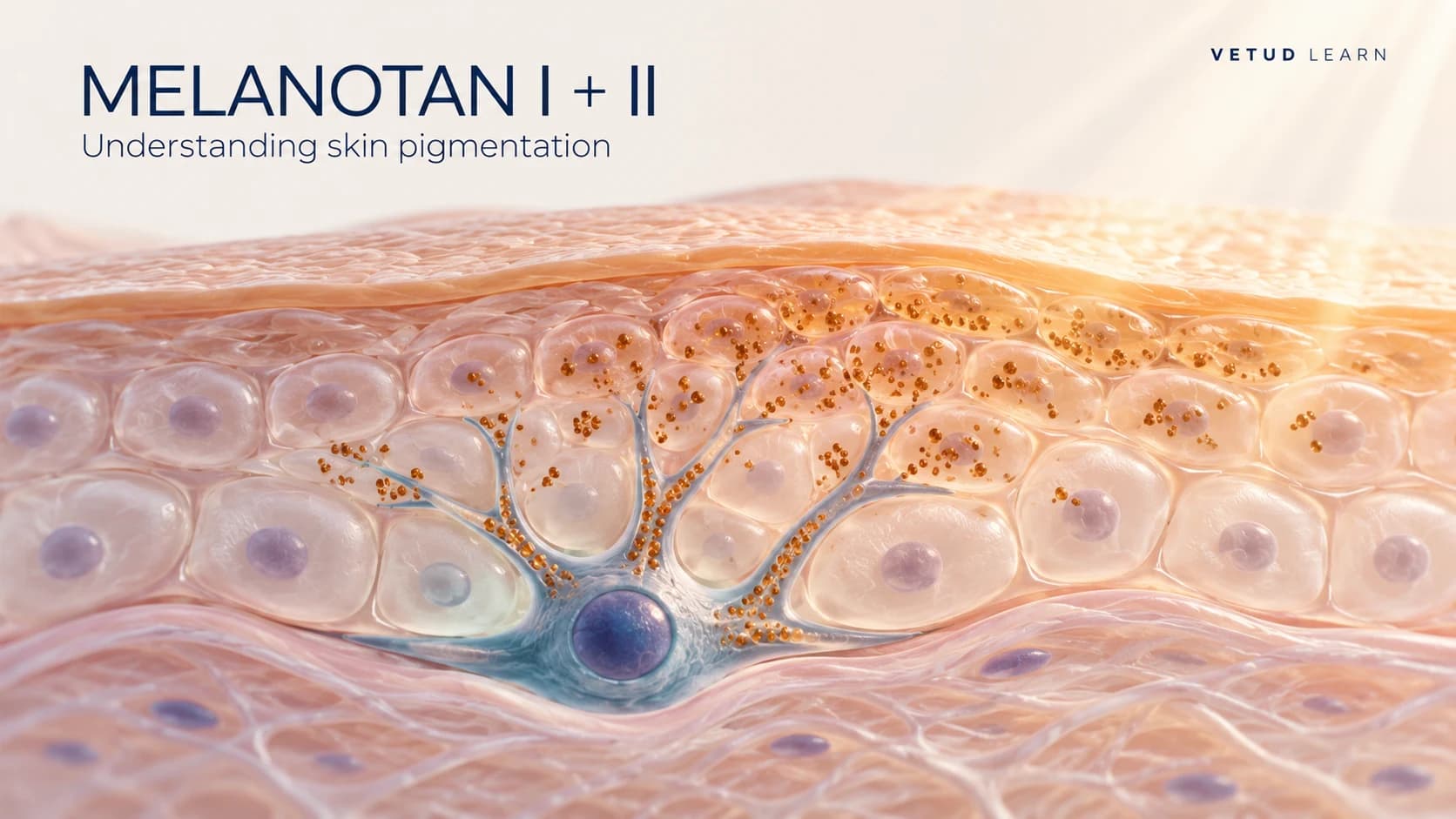
Both Melanotan peptides copy alpha-MSH, the hormone that tells skin to make melanin. Their stories then split.
Melanotan I, now called afamelanotide, went through proper trials for erythropoietic protoporphyria, a rare disease that makes sunlight painful. In the US trial of 94 patients, those given the implant spent a median of 69.4 hours in direct sunlight without pain over six months, compared with 40.8 hours on placebo. In the European trial of 74 patients, painful reactions were less frequent (77 versus 146). It is approved for this disease as Scenesse.
Melanotan II was tested in a 1996 pilot study in three healthy men over two weeks. It darkened the skin of two of them. It also caused mild nausea at most dose levels, sleepiness and tiredness in one man, and spontaneous erections lasting one to five hours.
It never went on to approval, but it spread through gyms and tanning salons. Dermatologists reported a 20-year-old woman diagnosed with melanoma, a dangerous skin cancer, three months after a three- to four-week course of self-injected Melanotan II combined with sunbeds. Other doctors have reported a kidney infarction, where part of a kidney loses its blood supply. Case reports cannot prove cause, but they flag risks that no trial has measured.
A 2026 review of unregulated “biohacking” drugs lists Melanotan II among unapproved peptides that “lack established human safety profiles”, with risks including contamination and inaccurate dosing.
Its relative PT-141 took the opposite path and became an approved medicine. Melanotan research material is listed in the research shop for laboratory use only.
What does this mean?
Melanotan I shows this hormone family can become a real medicine for a narrow use after proper trials. Melanotan II never had those trials.
What don’t we know yet?
How often Melanotan II causes serious harm, including whether it raises skin-cancer risk, has never been measured in a controlled study.
Watch and learn
Videos discussing the compounds in this article, plus background on the biology or the research methods. Each card explains its connection; recordings may predate the findings described here.
Dr Dray
Melanotan II: the truth about the viral “Barbie drug”
A dermatologist on why tanning injections worry skin doctors.
Andrea Suarez, MD, dermatologist
Discusses the compound
Discusses Melanotan I & II, PT-141 or its clinical context. Read the original studies linked here for the exact formulation, population and outcomes.
Rena Malik, M.D.
Bremelanotide (PT-141) and sexual desire
A clinician explains bremelanotide and sexual-health research. Approved indications and investigational uses should be distinguished.
Rena Malik, MD · urologist
Discusses the compound
Discusses Melanotan I & II, PT-141 or its clinical context. Read the original studies linked here for the exact formulation, population and outcomes.
National Institute of Mental Health
Clinical research: risks and benefits
Why an experimental treatment can involve uncertainty even when its scientific rationale sounds promising.
NIMH · US National Institutes of Health
Research skills
Helps you judge the study design or uncertainty in Melanotan I & II, PT-141 research; it is not a trial of the compound.
Sources and references
- Afamelanotide for Erythropoietic ProtoporphyriaLangendonk et al. · New England Journal of Medicine · 2015
- Evaluation of melanotan-II, a superpotent cyclic melanotropic peptide in a pilot phase-I clinical studyDorr et al. · Life Sciences · 1996
- Melanoma associated with the use of melanotan-IIHjuler & Lorentzen · Dermatology · 2014
- Melanotan II: a possible cause of renal infarctionPeters et al. · CEN Case Reports · 2020
- Dangers of Injectable Peptides and Other Unregulated “Biohacking” DrugsMoiz et al. · Missouri Medicine · 2026
VETUD Learn explains published research in plain language. It is general information, not medical advice. Talk to a doctor before starting, stopping or changing any treatment.
In the research shop
Check the catalog for related laboratory research materials. These products are separate from the approved medicines and clinical trial formulations discussed here.
Checking regional availability…