Copper peptides grew hair follicles in a dish. On scalps, the evidence is thin
AHK-Cu lengthened human hair follicles in the lab. The one small placebo-controlled trial we found tested a GHK combination, not copper peptides alone.
The study at a glance
- Lab study (2007)
- AHK-Cu lengthened human hair follicles kept alive outside the body
- Small trial (2016)
- 45 men with male pattern hair loss, 6 months
- What it tested
- A complex of the GHK peptide with 5-aminolevulinic acid, not AHK-Cu or GHK-Cu alone
- Hair count
- +52.6 and +71.5 hairs on two strengths vs +9.6 on placebo
- Length and thickness
- No significant difference between groups
The research, explained
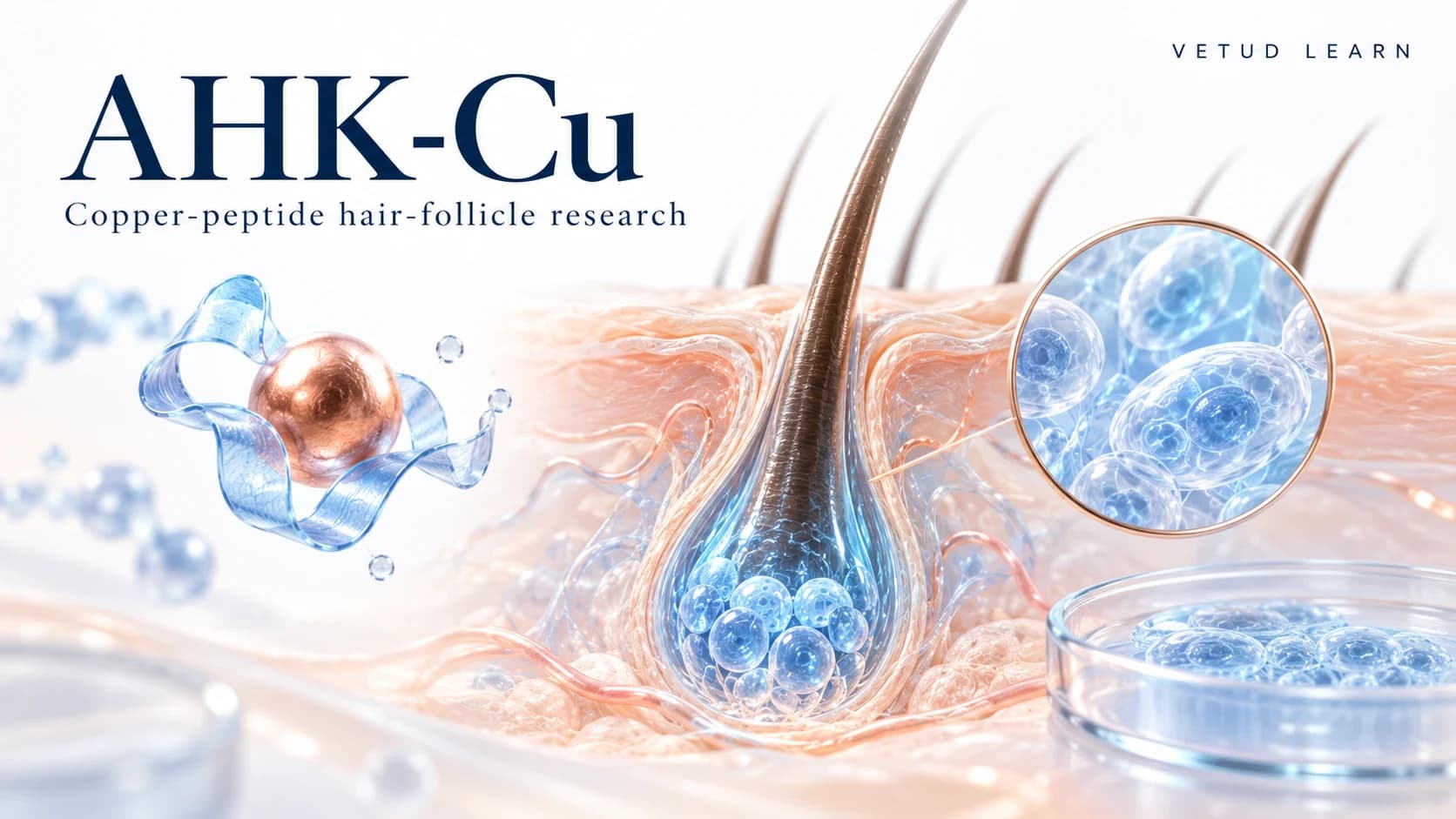
AHK-Cu and GHK-Cu are tiny copper-carrying peptides. GHK-Cu is a familiar skin-care ingredient; AHK-Cu is marketed mainly for hair.
The key lab study, from 2007, used human hair follicles kept alive outside the body. AHK-Cu made them lengthen, and made dermal papilla cells, which drive hair growth, multiply. It also shifted markers of cell death in a protective direction, although the drop in the number of dying cells was not statistically significant.
The only placebo-controlled trial on scalps we found involving one of these peptides tested something else: a complex of GHK with 5-aminolevulinic acid. Forty-five men with male pattern hair loss applied one of two strengths, or a placebo, once a day for six months.
Hair counts rose by 52.6 and 71.5 hairs on the two strengths, compared with 9.6 on placebo. Hair length and thickness did not differ between the groups, and no side effects were reported. With about 15 men per group and a combination product, the trial can’t show what GHK contributes on its own.
Established hair-loss treatments have far larger trials behind them. For copper peptides, the step from a dish to a scalp hasn’t been properly tested.
Copper-peptide research materials, where listed, are in the research shop for laboratory use.
What does this mean?
Copper peptides show hair-related activity in the lab. Whether they regrow hair on people’s heads hasn’t been tested in a proper trial.
What don’t we know yet?
Controlled trials of AHK-Cu or GHK-Cu on human scalps, and their long-term effects, are missing.
Watch and learn
Videos discussing the compounds in this article, plus background on the biology or the research methods. Each card explains its connection; recordings may predate the findings described here.
Dr. Aleksandra Brown
Dermatologist rates copper peptide serums
What copper peptides (GHK-Cu) can and can’t do in skin care.
Aleksandra Brown, DO, FAAD, dermatologist
Discusses the compound
Discusses AHK-Cu, GHK-Cu or its clinical context. Read the original studies linked here for the exact formulation, population and outcomes.
TED-Ed
Why do some people go bald?
An animated explanation of hair growth and hair loss, providing context for reading hair-research claims.
Lesson by Sarthak Sinha · hair-follicle biology
Related biology
Background on hair-follicle biology for understanding AHK-Cu, GHK-Cu. It does not demonstrate benefits of this compound or formulation.
National Institute of Mental Health
Different types of clinical research
An introduction to the different questions and designs used in studies involving people.
NIMH · US National Institutes of Health
Research skills
Helps you judge the study design or uncertainty in AHK-Cu, GHK-Cu research; it is not a trial of the compound.
Sources and references
- The effect of tripeptide-copper complex on human hair growth in vitroPyo et al. · Archives of Pharmacal Research · 2007
- Efficacy of a Complex of 5-Aminolevulinic Acid and Glycyl-Histidyl-Lysine Peptide on Hair GrowthLee et al. · Annals of Dermatology · 2016
- Regenerative and Protective Actions of the GHK-Cu Peptide in the Light of the New Gene DataPickart & Margolina · International Journal of Molecular Sciences · 2018
VETUD Learn explains published research in plain language. It is general information, not medical advice. Talk to a doctor before starting, stopping or changing any treatment.
In the research shop
Check the catalog for related laboratory research materials. These products are separate from the approved medicines and clinical trial formulations discussed here.
Checking regional availability…