A cream that targets an “aging switch” firmed skin in 12 weeks
In a controlled trial, a serum containing RLX-201 improved firmness, elasticity and sagging compared with the same cream without it.
The study at a glance
- Who took part
- 47 women with moderate to severe sun-damaged facial skin; 31 received RLX-201 and 16 received vehicle
- How it was tested
- Applied twice a day for 12 weeks; randomized and double-blind, against the same cream without RLX-201
- What improved
- Firmness, elasticity, sagging and overall skin quality, starting from week 2
- What people said
- More than 85% reported better radiance, texture and hydration
- Published in
- Journal of Cosmetic Dermatology, October 2026
The research, explained
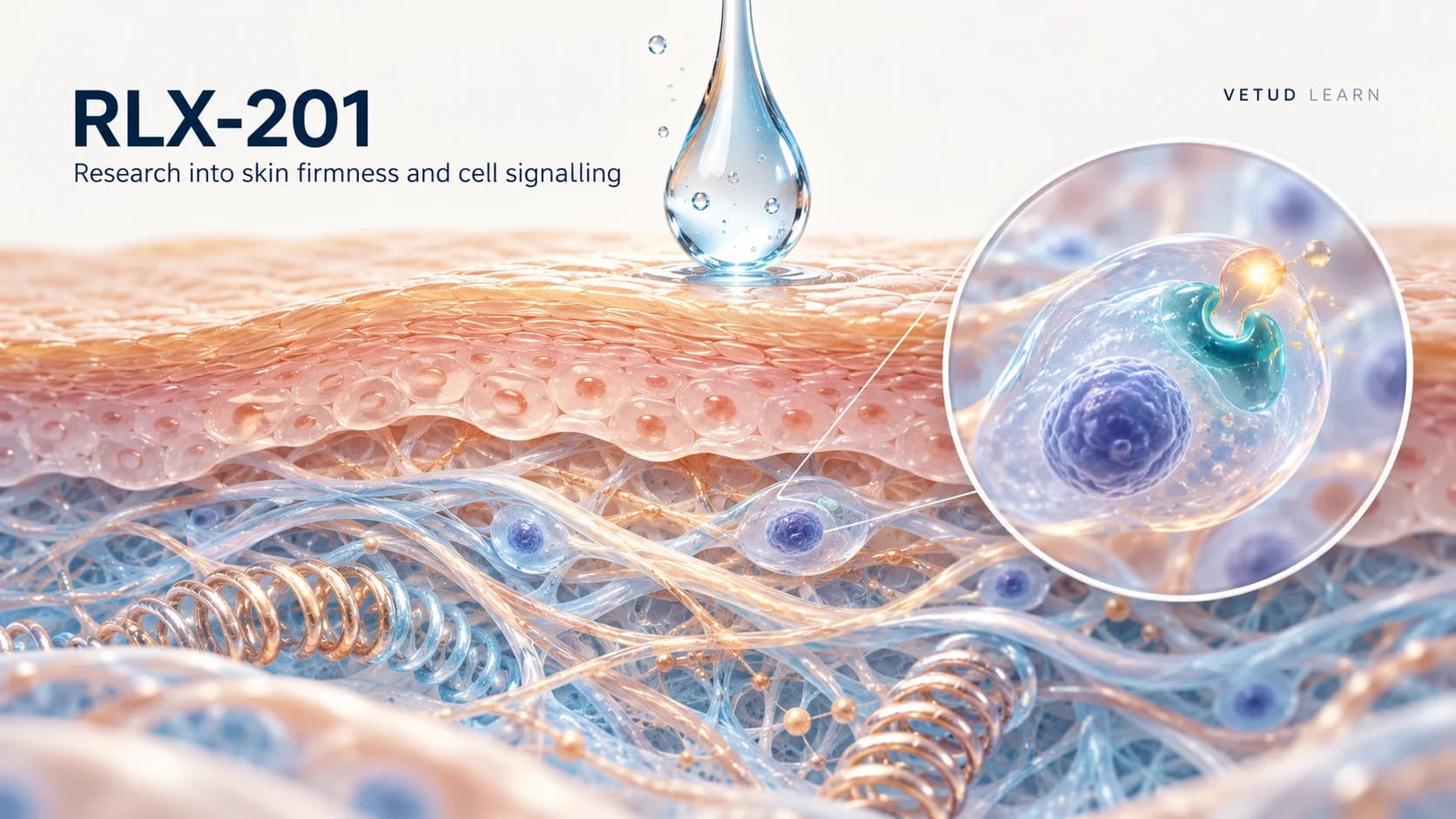
Most anti-aging creams work on the surface: they moisturize, exfoliate or add collagen-boosting ingredients. A new study tested a different idea: switching down one of the body’s main aging controls, right in the skin.
That control is called TORC1. It’s a sensor inside our cells that responds to nutrients and tells cells when to grow. Scientists link it to many of the processes of aging, and dialing it down is one of the most studied ideas in aging research. It’s how the drug rapamycin works.
Researchers gave women with sun-damaged facial skin either a serum containing RLX-201, a TORC1 blocker, or the same serum without it. Neither the women nor the investigators knew who had which. Skin was checked at the start and after 2, 4, 8 and 12 weeks.
The RLX-201 group had significantly firmer, more elastic and less saggy skin than the comparison group, and the difference showed up as early as week 2. Measurements with a device that tests how skin stretches and springs back agreed. More than 85% of the women using it said their skin looked more radiant, smoother and more hydrated.
In lab-grown human skin, the formula cut a marker of TORC1 activity by about 91%, a sign it was doing what it was designed to do.
What does this mean?
It’s an early sign that skin care aimed at the biology of aging, not just moisture or collagen, can make a visible difference.
What don’t we know yet?
This is a single-center, 12-week trial with 47 participants. Some authors are affiliated with the developer. Longer, independent studies are needed. RLX-201 is not a peptide, and this trial did not test GHK-Cu.
Watch and learn
Background on cellular ageing, clinical research and a different skincare ingredient. These videos do not test RLX-201, and copper peptides are not the TORC1 inhibitor studied in the article.
TED
The science of cells that never get old
The discovery and biology of telomeres. This is not a trial of epitalon or any anti-ageing product.
Elizabeth Blackburn, PhD · Nobel laureate in telomere research
Related biology
Background on telomeres and cellular ageing for understanding GHK-Cu. It does not demonstrate benefits of this compound or formulation.
National Institute of Mental Health
What is clinical research?
Why studies in people are needed and what clinical research is designed to establish.
NIMH · US National Institutes of Health
Research skills
Helps you judge the study design or uncertainty in GHK-Cu research; it is not a trial of the compound.
Dr. Aleksandra Brown
Dermatologist rates copper peptide serums
What copper peptides (GHK-Cu) can and can’t do in skin care.
Aleksandra Brown, DO, FAAD, dermatologist
Related biology
Background on topical copper-peptide skincare for understanding GHK-Cu. It does not demonstrate benefits of this compound or formulation.
Sources and references
- A novel TORC1 inhibitor, RLX-201, improves skin health, biomechanics, and extracellular matrix integrity in a double-blind clinical studyDraelos et al. · Journal of Cosmetic Dermatology · 2026
VETUD Learn explains published research in plain language. It is general information, not medical advice. Talk to a doctor before starting, stopping or changing any treatment.
In the research shop
Check the catalog for related laboratory research materials. These products are separate from the approved medicines and clinical trial formulations discussed here.
Checking regional availability…